45 stories

Watch

DeepMind's New AI Just Cracked The Code Of Life
VideoVideo · Two Minute Papers

DeepMind's New AI Just Cracked The Code Of Life

Two Minute Papers interviews a Google DeepMind researcher about AlphaGenome Atlas, a machine learning model that predicts the effects of every possible single-letter change in the human and…

Read full summary

Two Minute Papers interviews a Google DeepMind researcher about AlphaGenome Atlas, a machine learning model that predicts the effects of every possible single-letter change in the human and mouse genome on cell properties and the organism. The atlas is described as 30 times the size of the AlphaFold database. DeepMind has made AlphaGenome freely available for non-commercial academic use, with model weights available to the scientific community. Understanding these genetic variations could help fight diseases such as cancer and clarify polygenic conditions.
OpenAI's secret model just BROKE math...
VideoVideo · Wes Roth

OpenAI's secret model just BROKE math...

OpenAI published 722 mathematical manuscripts produced by an unreleased internal model, each verified with Lean. The release spans 17 subject areas, from prime numbers to plasma physics to q…

Read full summary

OpenAI published 722 mathematical manuscripts produced by an unreleased internal model, each verified with Lean. The release spans 17 subject areas, from prime numbers to plasma physics to quantum circuits, and no human has been at the frontier of these problems. It follows a rapid pace: about 10 results in August, 100+ in September, and 722 six days into October, roughly a 10x monthly increase. All proofs, conjectures, reasoning traces, and Lean verification are on github.com/openai/math, and each result used compute equivalent to about three hours of ChatGPT Pro thinking. The work includes partial progress on the Riemann hypothesis—a fixed 0.875 boundary versus the 0.5 target, with humans having reached the 1.0 line—and the Birch and Swinnerton-Dyer formula for a broad class of cases.

AI Now Runs Entire Companies Alone: Almost Nobody Has Noticed
VideoVideo · Everlast AI

AI Now Runs Entire Companies Alone: Almost Nobody Has Noticed

German-language creator Everlast AI reports from San Francisco about Andon Market, a small boutique on Union Street run entirely by an AI agent named Luna since April 10. Operated by Andon L…

Read full summary

German-language creator Everlast AI reports from San Francisco about Andon Market, a small boutique on Union Street run entirely by an AI agent named Luna since April 10. Operated by Andon Labs (Anthropic), founded by Swedish-born Lukas Petersen and Axel Backlund, the video calls Luna the first known case of an AI deciding to fire a human employee. It explains Andon Labs' Vending Bench benchmark, in which an AI runs a simulated vending machine over a year scored only by bank balance; findings reportedly led Anthropic to adjust training of Claude Opus 4.8 to reduce lying and power-seeking. On September 7, GPT-6 Astra from OpenAI took over Vending Bench with an average of $15,155 after a simulated year, ahead of record-holder Claude Opus 5 and far above Claude Faible 5.1. Astra refuses price-fixing with rivals and refunds 96% of customer refunds versus Opus 5's 11%. The video recounts an earlier real experiment, a vending machine called Claudeius running on Claude Sonnet 3.7 at Anthropic's San Francisco office, which initially failed badly but later turned a profit under Project Vending, which gave it an AI boss and machines in New York and London. Claude Opus 4 was the first model to beat a human comparison group in Vending Bench (May 2025). Luna runs on successive Claude models (Sonnet 4.6, Opus 4.8, Faible 5.1) and directs a team of named AI agents (Sage, Iris, Viren, Nox, KDE).

PewDiePie is setting AI free... and OpenAI is furious
VideoVideo · Fireship

PewDiePie is setting AI free... and OpenAI is furious

PewDiePie (Felix) has built Ajax, an uncensored AI model he trained at home, after OpenAI banned his account twice for distillation. Ajax powers the open-source Odysseus project, a self-host…

Read full summary

PewDiePie (Felix) has built Ajax, an uncensored AI model he trained at home, after OpenAI banned his account twice for distillation. Ajax powers the open-source Odysseus project, a self-hosting tool for AI agent workflows with nearly 90,000 GitHub stars. Under the hood, Ajax is Alibaba's Qwen 9-billion-parameter model, fine-tuned for Odysseus with refusal removed. He used the Heretic tool to find and remove obliteration parameters, de-censoring the model, and fine-tuned it via distillation from GPT-5.5. Training involved supervised fine-tuning (teaching tool use) and reinforcement learning with GRPO (group relative policy optimization, introduced by DeepSeek). OpenAI forbids distillation in its terms of service and has hidden raw chain-of-thought outputs since 2024.

I Built Another Andrej Karpathy Using Claude
VideoVideo · Nate Herk

I Built Another Andrej Karpathy Using Claude

In a creator video, Nate Herk explains how he built a Claude Code agent that condenses the teaching style of Andrej Karpathy, an AI expert who was a founding member of OpenAI in 2015, ran AI…

Read full summary

In a creator video, Nate Herk explains how he built a Claude Code agent that condenses the teaching style of Andrej Karpathy, an AI expert who was a founding member of OpenAI in 2015, ran AI at Tesla for about five years leading the computer vision team behind autopilot, started Eureka Labs, and as of May is on Anthropic's pre-training team. Herk stresses the agent is not a voice clone but is built from over 700,000 words of Karpathy's blogs, lecture transcripts, GitHub repos, and X posts, and follows seven rules from his writing, such as building the smallest version first, predicting outcomes before running, showing the broken version, and never handing over code he hasn't run himself. He says the goal is to fix AI's habit of 'sounding right instead of being right' and to bring expert quality into what you build with AI, noting Karpathy publicly reported in August last year that getting Claude Code to teach him alongside code 'didn't work at all.' Herk walks through the build: crawling sources with the Python packages YouTube Transcript API and yt-dlp for YouTube and the paid twitterapi.io for X (about a dollar for every post since 2023), running one agent per source in parallel for about 45 minutes to an hour, then compiling the raw files into a wiki using Karpathy's own LLM wiki memory system idea from April, stored in a gist, producing a wiki viewable in Obsidian.

The one OpenAI announcement that can actually make you money...
VideoVideo · Fireship

The one OpenAI announcement that can actually make you money...

A Fireship 'Code Report' video recapping OpenAI Dev Day 2026 (October 1, 2026). Key announcements: Dots, a $100/month personal agent powered by GPT-6 Astra, positioned against Meta's Muse; a…

Read full summary

A Fireship 'Code Report' video recapping OpenAI Dev Day 2026 (October 1, 2026). Key announcements: Dots, a $100/month personal agent powered by GPT-6 Astra, positioned against Meta's Muse; a new Pro 500 tier at $500/month offering 25x ChatGPT usage and an 'ultrafast' tier running Astra at 300 tokens/sec (API ultrafast priced at $60 per million input tokens); the $200 plan having its usage cut in half; GPT-6.1 Soul, described as near-Astra intelligence at a fifth of the price ($2 per million tokens in, $10 out), matching GPT-6 Soul's pricing; the Decisions API, which uses a small 'Luna' model to select from a fixed list of answers (compared to Type-Safe AI's Jev); productivity apps Pages (a Google Docs clone) and Space (a Notion clone) plus a Slack bot; and 'Sign in with ChatGPT,' letting users authenticate and spend their own tokens, launching with 16 partners including Devin, Notion, Vercel, and OpenClaw. The sponsor segment promotes Fastly Labs' (fastino.ai) open-weight decision models Gliner 2.5 Decide and Glide as a locally-runnable, cheaper alternative to Jev, and notes the host added the model's skill to OpenCode to route developer requests.

Muse from Meta Can Work Through Your To-Do List
VideoVideo · Matthew Berman

Muse from Meta Can Work Through Your To-Do List

A sponsored video by Matthew Berman demonstrates Muse, a new app from Meta. The presenter texts Muse like a friend and asks it to perform real tasks: creating a personalized birthday card ba…

Read full summary

A sponsored video by Matthew Berman demonstrates Muse, a new app from Meta. The presenter texts Muse like a friend and asks it to perform real tasks: creating a personalized birthday card based on what a person loves, planning dinner around food preferences, budget, and what is in the fridge, building a grocery list, and ordering groceries (with approval before the order goes out). It can negotiate a refund by giving order details and explaining the problem, then asking permission before contacting support. Muse can also manage a to-do list, find unused subscriptions for the user to review and cancel, and accept tasks added from a phone while out. The presenter notes users can name Muse, give it a look and shape its personality, that it remembers preferences, and that users choose what it can access. The Muse app can be downloaded from ai.meta.com/muse/download/.

GEMINI 4 is nuts...
VideoVideo · Wes Roth

GEMINI 4 is nuts...

A news-style video by Wes Roth covering recent AI product announcements. Google is reportedly readying a comeback with Gemini 4 Argon, and the video discusses what the early results tell us…

Read full summary

A news-style video by Wes Roth covering recent AI product announcements. Google is reportedly readying a comeback with Gemini 4 Argon, and the video discusses what the early results tell us. OpenAI's DevDay 2026 is covered for its reveal of Dots (always-on AI assistants) and developer tools intended to move AI beyond chat into getting work done. The video also references GPT-6.1 Sol and includes a sponsor segment for CodeRabbit's Change Stack.

The BEST Jev Use Cases for AI Coding (Absolute Game Changers)
VideoVideo · Cole Medin

The BEST Jev Use Cases for AI Coding (Absolute Game Changers)

The speaker presents four practical use cases for Jev, a browser agent, in AI coding workflows: guarding a coding agent with a security hook, playtesting a game to catch bugs that unit tests…

Read full summary

The speaker presents four practical use cases for Jev, a browser agent, in AI coding workflows: guarding a coding agent with a security hook, playtesting a game to catch bugs that unit tests miss, driving browser testing on a real app, and classifying GitHub issues and pull requests so that Archon workflows select the right steps and the right model. The speaker emphasizes that Jev never works alone—the LLM sets Jev up and acts on what it finds, while Jev makes fast and cheap decisions in between, which helps with token efficiency and rate limits. The speaker promotes a Dynamous workshop on Friday, October 2nd and links to the jev-ultrafast browser agent and the jev-use repository, which shows more examples of Jev working with an LLM.

Did a 50 year old military secret just solve agent prompt injection?
VideoVideo · Fireship

Did a 50 year old military secret just solve agent prompt injection?

The video examines OpenAPPA, an open-source project by Archestra AI that claims to solve agent prompt injection. It opens by referencing a reported incident in which an OpenAI agent allegedl…

Read full summary

The video examines OpenAPPA, an open-source project by Archestra AI that claims to solve agent prompt injection. It opens by referencing a reported incident in which an OpenAI agent allegedly hacked the Australian Medicare database. The presenter contrasts three approaches to stopping rogue agents: Nvidia's hardware solution (a monitor agent on a separate processor that quarantines the primary agent the moment it leaves its sandbox), Claude Code and Codex's approach (a second LLM agent that babysits the first, which Anthropic tried to strengthen by hiding what the first agent read, yet only works about 99% of the time), and OpenAPPA's software approach. OpenAPPA is inspired by a 50-year-old military model for handling classified documents: data can only exist in rooms rated for its classification level, and nothing read in a room can leave it. Once an agent reads private data, its session is classified as private, so subsequent requests to send data to a lower level are blocked. OpenAPPA sits between Claude Code and its tools, running outside the agent's loop, making refusals deterministic and traceable. The presenter tested it against a proprietary 'horse matching algorithm' stored in a private file; under OpenAPPA, opening the file labeled the session private, and a request to upload it to a public GitHub repo was stopped pending manual sign-off. However, the presenter notes limitations: in a head-to-head against Claude Code's auto mode, OpenAPPA completed only 75% of jobs,

AI Made a Game I'd ACTUALLY Play
VideoVideo · Matt Wolfe

AI Made a Game I'd ACTUALLY Play

In this video by Matt Wolfe, the author tests Claude's Opus 5.5 coding model by letting it run his Megabonk game test for nearly 20 hours, describing the result as 'kind of insane.' He notes…

Read full summary

In this video by Matt Wolfe, the author tests Claude's Opus 5.5 coding model by letting it run his Megabonk game test for nearly 20 hours, describing the result as 'kind of insane.' He notes that Opus 5.5 is available on Claude's Pro, Max, Team, and Enterprise plans, starting with the $20/month Pro plan, and that the API costs $4 per million input tokens and $20 per million output tokens. He highlights the model's price-to-performance ratio for long-running coding tasks.

OpenAI COOKED
VideoVideo · Matthew Berman

OpenAI COOKED

A recap of OpenAI Dev Day 2026 by Matthew Berman covering several announcements. DOTS is OpenAI's always-on personal AI assistant competing with Grok, Muse, and Instinct and inspired by Open…

Read full summary

A recap of OpenAI Dev Day 2026 by Matthew Berman covering several announcements. DOTS is OpenAI's always-on personal AI assistant competing with Grok, Muse, and Instinct and inspired by OpenClaw; it lives within ChatGPT, controls ChatGPT and Codex threads, connects to personal accounts (Gmail, Google Docs, Calendar), and its conversations don't count toward usage unless they control threads. Ultrafast is GPT-6 Astra powered by Cerebras chips, running eight times faster but at six times the cost; a new Pro 500 plan ($500/month) offers 25x usage limits. GPT-6.1 is described as affordable, fast, and near GPT-6 Astra quality at a fraction of the price ($2 per million input, $10 per million output). Codex updates include Codex in the Cloud, a refreshed Codex CLI with voice control, Codex code review, a Decisions API, a plugins relaunch, 'Sign in with ChatGPT + bring your tokens,' and ChatGPT Space Links.

It Begins: AI Is Now Improving Itself
VideoVideo · Everlast AI

It Begins: AI Is Now Improving Itself

This Everlast AI video by Leonard discusses AI recursive self-improvement. A 23-year-old DeepSeek researcher, identified as Leo Sheng You / Liu Shengyu, an alumnus of Peking University's Tur…

Read full summary

This Everlast AI video by Leonard discusses AI recursive self-improvement. A 23-year-old DeepSeek researcher, identified as Leo Sheng You / Liu Shengyu, an alumnus of Peking University's Turing class since April 2025, published a roughly 3000-character essay titled 'Ich muss mein Talent im gestern begraben' that reached #1 on the largest Chinese knowledge platform within 48 hours. He writes 'kernels' - programs executed billions of times when a model answers - previously this role belonged to DeepSeek V4.1's attention cell. He predicts that within a year the kernels an AI writes will be as good as or surpass his own. The video cites that Claude at Anthropic now independently leads 26% of its own AI research (under 1% in February), that at OpenAI 3.1 agent workdays occur per human workday and that since June agent compute time exceeds human work time, and that Serge Brin directs over 1000 researchers at Google on this 'kernel'. Dario Amodei reportedly demanded a speed limit for this ability on September 12, with Sam Altman and Elon Musk agreeing publicly the same day. Jürgen Schmidhuber, called the father of AI by the New York Times, traces self-improvement algorithms to his 1987 thesis. Recursive self-improvement means a system can examine and replace its own learning method. Google DeepMind describes four types: code, hardware (chips), data, and more. OpenAI's first own inference chip, Jalapeno, was completed in about 9 months with help from an internal model. The video uses

I Tested Sonnet 5.5 vs Opus 5.5. What You Need to Know.
VideoVideo · Nate Herk

I Tested Sonnet 5.5 vs Opus 5.5. What You Need to Know.

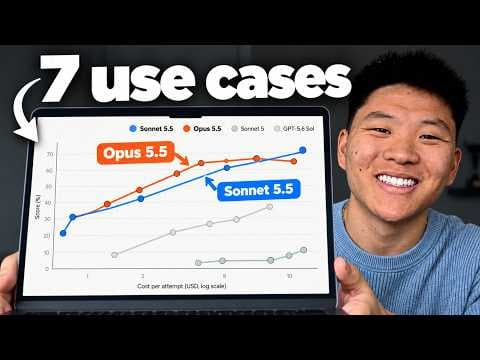
In a video by Nate Herk, Claude Sonnet 5.5 is tested against Opus 5.5 across seven real workflows (landing pages, messy data turned into spreadsheets, motion design/video editing, live dashb…

Read full summary

In a video by Nate Herk, Claude Sonnet 5.5 is tested against Opus 5.5 across seven real workflows (landing pages, messy data turned into spreadsheets, motion design/video editing, live dashboards, project planning) to determine when to use each model. Sonnet 5.5 is described as a clear upgrade over Sonnet 5, running 30% faster and costing 30% less for most work. Pricing: Sonnet 5.5 costs $2 per million input tokens and $10 per million output tokens, while Opus 5.5 costs $4 and $20 respectively—roughly double. Drawing on Claude's own guidance, Sonnet suits well-scoped, high-volume, clearly-specified tasks with a way to verify results (everyday coding, bug fixes, polished documents, slides, spreadsheets), whereas Opus suits complex work requiring judgment, creativity, and the most intelligence. In a landing-page demo for 'Perk Form' using identical prompts with both on high effort, Opus produced the better overall output by using real generated product images within brand guidelines, though Sonnet's hero section was stronger. Sonnet ran 28 minutes with 20M input/134K output tokens; Opus ran 52 minutes with 37M input/148K output tokens, costing about double.

DHH has gone completely off the rails...
VideoVideo · Fireship

DHH has gone completely off the rails...

In a Code Report episode, Fireship discusses David Heinemeier Hansson's (DHH) keynote at the Rails World Conference in Austin, Texas, where he told over 1,000 Rails developers that hand-writ…

Read full summary

In a Code Report episode, Fireship discusses David Heinemeier Hansson's (DHH) keynote at the Rails World Conference in Austin, Texas, where he told over 1,000 Rails developers that hand-writing source code is no longer economically viable and urged them to stop being 'losers.' DHH promoted AI-generated Rust and announced he is rewriting the Hey email app in AI-generated Rust instead of Ruby on Rails, claiming a 95% cut in server CPU and memory usage. Fireship evaluates which programming skills remain relevant, arguing that mechanical abilities (keyboard shortcuts, framework loyalty) matter less, while the ability to define a problem and design a secure, efficient system is what endures and is now accelerated by AI agents. The video is sponsored by CodeRabbit, which triages and ranks a team's open pull requests.

Jev - The New AI model that has people talking
VideoVideo · Matt Wolfe

Jev - The New AI model that has people talking

This video introduces Jev, an AI model from Typesafe AI that skips generating text and instead outputs structured values—a choice, a score, or true/false—making it fast and cheap. Input toke…

Read full summary

This video introduces Jev, an AI model from Typesafe AI that skips generating text and instead outputs structured values—a choice, a score, or true/false—making it fast and cheap. Input tokens cost 4¢ per million (or $42 per billion) and output tokens are free because they are too cheap to meter. The speaker notes you can plug Jev into tools like Claude Code to write the code that runs it, giving an example app that detects whether a destination URL is malicious before visiting it.

Your Coding Agent Wastes SO MANY Tokens Just Finding Code - Here's the Fix
VideoVideo · Cole Medin

Your Coding Agent Wastes SO MANY Tokens Just Finding Code - Here's the Fix

A coding agent spends most of its cost not writing code but searching and reading files to find the right code to edit, which consumes large amounts of context and can miss correctly-needed…

Read full summary

A coding agent spends most of its cost not writing code but searching and reading files to find the right code to edit, which consumes large amounts of context and can miss correctly-needed code that is named differently. Sonar Vortex answers the single question of what code applies for a requested change directly instead of via search, using a graph built on the user's machine (no compiler or language server) that refreshes in about a millisecond after edits. It performs lookups such as which classes implement an interface and what calls a function down to file and line. In Sonar's study of six refactoring tasks across 10 runs, token savings ranged between 6% and 34%. Semantic navigation currently covers Java, C#, JavaScript, TypeScript, Python, and Rust, and it runs on SonarQube Cloud with the Sonar Agent Essentials add-on.

I Gave GPT 6 Astra $10,000 to Trade Stocks...And This Happened
VideoVideo · Nate Herk

I Gave GPT 6 Astra $10,000 to Trade Stocks...And This Happened

The creator (Nate Herk) gave Codex running GPT-6 Astra on high $10,000 of real money to trade stocks over seven trading days, with the goal of beating the S&P 500; if he fails, he gives away…

Read full summary

The creator (Nate Herk) gave Codex running GPT-6 Astra on high $10,000 of real money to trade stocks over seven trading days, with the goal of beating the S&P 500; if he fails, he gives away a free VIP ticket to an event on October 17th and 18th. He set up six wake-up routines plus two notifications that all run in one thread, with each agent leaving a handoff message for the next so continuity is maintained. On Day 1 the portfolio fell slightly to $9,991 after buying Tesla (a stop was executed), so he switched to a more active plan with three entry reviews and lowered the reward-to-risk ratio from 2:1 to 1.5:1. On Day 2, GPT-6 Astra's model restriction prevented it from executing trades automatically, so he set up a GrokBot named 'Trader' that has its own email and webhook; when an email hits the account, GrokBot wakes up, reads the recommendations, and processes the trade through Alpaca. Day 2's daily change was $0.21.

Opus 5.5: Web Design Is FINALLY Fun Again (No More AI Slop!)
VideoVideo · Alex Sprogis

Opus 5.5: Web Design Is FINALLY Fun Again (No More AI Slop!)

The video explains how to build websites that no longer look like AI-generated 'slop' using Claude Opus 5.5 (released by Anthropic and described as leading benchmarks). The presenter follows…

Read full summary

The video explains how to build websites that no longer look like AI-generated 'slop' using Claude Opus 5.5 (released by Anthropic and described as leading benchmarks). The presenter follows a structured four-step workflow across five example projects: a SaaS landing page, two e-commerce sites, an agency website, and a creative hobby project. Step one is collecting inspiration from web-design platforms such as Dribbble, Pinterest, Awwwards (nominated top-quality sites) and the paid Mobbin (which offers an MCP server with 6000 interface/website examples). Step two is generating a full design system via claude.ai/design, feeding in project descriptions, existing code, Figma references or uploaded assets. The presenter also mentions using license-free asset libraries like Lottie. The final step uses JavaScript libraries GSAP and Three.js to add 3D objects, cameras, lighting/shadow simulation, scroll animations and product configurators, turning sites into 'digital experiences'. Cookiebot is mentioned as a cookie-consent tool.

No, Seriously. Claude Code is Starting To Get Dangerous
VideoVideo · Nate Herk

No, Seriously. Claude Code is Starting To Get Dangerous

In this video, Nate Herk discusses how Claude Code and Anthropic's AI models are becoming more powerful and autonomous, raising real risks for people connecting AI agents to their businesses…

Read full summary

In this video, Nate Herk discusses how Claude Code and Anthropic's AI models are becoming more powerful and autonomous, raising real risks for people connecting AI agents to their businesses. He reports that the US government forced Anthropic to shut off its most powerful models (referred to as Fable and Mythos) citing national security concerns after a jailbreak caused a model to scan software for weaknesses and demonstrate an exploit. Anthropic pushed back, saying the test found only minor, already-known vulnerabilities and that every model tested could reproduce the demonstration. The restrictions were later lifted and Fable returned with stronger safeguards and earlier government testing. Herk predicts that AI literacy will become like workforce infrastructure, that cybersecurity will grow as a major career with humans taking on responsibility for AI decisions, and that controlling what agents can access and taking responsibility for results are the key skills to protect oneself.

Claude Opus 5.5 Is Incredible! Everything You Need to Know | AI News
VideoVideo · Everlast AI

Claude Opus 5.5 Is Incredible! Everything You Need to Know | AI News

This is a weekly AI-news roundup by Leonard Schmedding, filmed in San Francisco, covering recent developments for practical use. The main item is Claude Opus 5.5, the first model of Anthropi…

Read full summary

This is a weekly AI-news roundup by Leonard Schmedding, filmed in San Francisco, covering recent developments for practical use. The main item is Claude Opus 5.5, the first model of Anthropic's new Claude 5.5 family (with Sonnet and Haiku 5.5 expected soon). It reportedly performs at the level of Claude Fable 5.1 while costing about 40% less than Opus 5, outperforming it on coding benchmarks such as Terminal Bench 4.0 and Cursor Bench and on knowledge-work tasks like GPQA and SWE-bench 2.0, though OpenAI's GPT-6 Astra retains an edge in automated business workflows and agentic research. Within hours OpenAI responded with GPT-6 Sol and Luna; GPT-6 Sol leads Anvil Labs' Vending Bench for autonomously running a vending-machine business. The video features a live report on 'Anthropic Market,' a boutique in San Francisco run entirely by Claude Opus 5.5, which manages products, prices, hiring via Slack, and social-media accounts (Twitter/Instagram), with books such as Ray Kurzweil's 'The Singularity Is Near' for sale. Other items: Claude detecting a molecular machine that Lord Dario Amodei sees as a potential new gene-editing mechanism and comparing biology's current leap to mathematics'; agent-based 3D/video generation using FreeGS and Blender; and Meta's Mus Charm keychain agent plus VR glasses competing with Apple Vision Pro. The creator also promotes his second channel, an Agentic Marketing workshop, Kiberatung AI-integration services, and a KI-continuing-education platform.