OpenAI and Ironclad are collaborating to train and evaluate AI agents on complex contracting workflows in order to advance computer use for professional work.
GitHub now allows users to request a GitHub Copilot code review through the REST and GraphQL APIs and to set the review effort level for each request. The Balanced effort…
Read full summary
GitHub now allows users to request a GitHub Copilot code review through the REST and GraphQL APIs and to set the review effort level for each request. The Balanced effort level is now the default.
As of October 2, 2026, GitHub deprecated selected models across all GitHub Copilot experiences, including Copilot Chat, inline edits, ask and agent modes, and code comple…
Read full summary
As of October 2, 2026, GitHub deprecated selected models across all GitHub Copilot experiences, including Copilot Chat, inline edits, ask and agent modes, and code completions. The announcement appeared on The GitHub Blog.
This guide explains how startups can choose GPT-6 family models, tune reasoning effort, improve prompts and skills, coordinate tools, and prepare workflows for production…
Read full summary
This guide explains how startups can choose GPT-6 family models, tune reasoning effort, improve prompts and skills, coordinate tools, and prepare workflows for production.
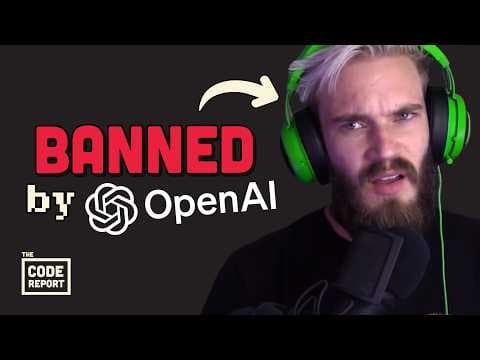
PewDiePie (Felix) has built Ajax, an uncensored AI model he trained at home, after OpenAI banned his account twice for distillation. Ajax powers the open-source Odysseus project, a self-host…
Read full summary
PewDiePie (Felix) has built Ajax, an uncensored AI model he trained at home, after OpenAI banned his account twice for distillation. Ajax powers the open-source Odysseus project, a self-hosting tool for AI agent workflows with nearly 90,000 GitHub stars. Under the hood, Ajax is Alibaba's Qwen 9-billion-parameter model, fine-tuned for Odysseus with refusal removed. He used the Heretic tool to find and remove obliteration parameters, de-censoring the model, and fine-tuned it via distillation from GPT-5.5. Training involved supervised fine-tuning (teaching tool use) and reinforcement learning with GRPO (group relative policy optimization, introduced by DeepSeek). OpenAI forbids distillation in its terms of service and has hidden raw chain-of-thought outputs since 2024.
In a creator video, Nate Herk explains how he built a Claude Code agent that condenses the teaching style of Andrej Karpathy, an AI expert who was a founding member of OpenAI in 2015, ran AI…
Read full summary
In a creator video, Nate Herk explains how he built a Claude Code agent that condenses the teaching style of Andrej Karpathy, an AI expert who was a founding member of OpenAI in 2015, ran AI at Tesla for about five years leading the computer vision team behind autopilot, started Eureka Labs, and as of May is on Anthropic's pre-training team. Herk stresses the agent is not a voice clone but is built from over 700,000 words of Karpathy's blogs, lecture transcripts, GitHub repos, and X posts, and follows seven rules from his writing, such as building the smallest version first, predicting outcomes before running, showing the broken version, and never handing over code he hasn't run himself. He says the goal is to fix AI's habit of 'sounding right instead of being right' and to bring expert quality into what you build with AI, noting Karpathy publicly reported in August last year that getting Claude Code to teach him alongside code 'didn't work at all.' Herk walks through the build: crawling sources with the Python packages YouTube Transcript API and yt-dlp for YouTube and the paid twitterapi.io for X (about a dollar for every post since 2023), running one agent per source in parallel for about 45 minutes to an hour, then compiling the raw files into a wiki using Karpathy's own LLM wiki memory system idea from April, stored in a gist, producing a wiki viewable in Obsidian.
A Fireship 'Code Report' video recapping OpenAI Dev Day 2026 (October 1, 2026). Key announcements: Dots, a $100/month personal agent powered by GPT-6 Astra, positioned against Meta's Muse; a…
Read full summary
A Fireship 'Code Report' video recapping OpenAI Dev Day 2026 (October 1, 2026). Key announcements: Dots, a $100/month personal agent powered by GPT-6 Astra, positioned against Meta's Muse; a new Pro 500 tier at $500/month offering 25x ChatGPT usage and an 'ultrafast' tier running Astra at 300 tokens/sec (API ultrafast priced at $60 per million input tokens); the $200 plan having its usage cut in half; GPT-6.1 Soul, described as near-Astra intelligence at a fifth of the price ($2 per million tokens in, $10 out), matching GPT-6 Soul's pricing; the Decisions API, which uses a small 'Luna' model to select from a fixed list of answers (compared to Type-Safe AI's Jev); productivity apps Pages (a Google Docs clone) and Space (a Notion clone) plus a Slack bot; and 'Sign in with ChatGPT,' letting users authenticate and spend their own tokens, launching with 16 partners including Devin, Notion, Vercel, and OpenClaw. The sponsor segment promotes Fastly Labs' (fastino.ai) open-weight decision models Gliner 2.5 Decide and Glide as a locally-runnable, cheaper alternative to Jev, and notes the host added the model's skill to OpenCode to route developer requests.
Chatham Financial uses OpenAI's Codex and GPT-5.6 to build technology and redesign workflows, reducing trade validation time from 30 minutes to under 4 minutes.
Computer use is now available in public preview in GitHub Copilot CLI and the GitHub Copilot app on macOS and Windows. Copilot can interact with desktop applications on the user's behalf.
At the WeAreDevelopers event, Docker introduced Cloud Sandboxes, an open Sandbox Kit specification, and a commitment to bring Kits to the CNCF for neutral governance. The offering is framed around running agents that use…
Read full summary
At the WeAreDevelopers event, Docker introduced Cloud Sandboxes, an open Sandbox Kit specification, and a commitment to bring Kits to the CNCF for neutral governance. The offering is framed around running agents that users do not fully trust.
A sponsored video by Matthew Berman demonstrates Muse, a new app from Meta. The presenter texts Muse like a friend and asks it to perform real tasks: creating a personalized birthday card based on what a person loves, pl…
Read full summary
A sponsored video by Matthew Berman demonstrates Muse, a new app from Meta. The presenter texts Muse like a friend and asks it to perform real tasks: creating a personalized birthday card based on what a person loves, planning dinner around food preferences, budget, and what is in the fridge, building a grocery list, and ordering groceries (with approval before the order goes out). It can negotiate a refund by giving order details and explaining the problem, then asking permission before contacting support. Muse can also manage a to-do list, find unused subscriptions for the user to review and cancel, and accept tasks added from a phone while out. The presenter notes users can name Muse, give it a look and shape its personality, that it remembers preferences, and that users choose what it can access. The Muse app can be downloaded from ai.meta.com/muse/download/.
Code coverage uploads from the GitHub Code Quality upload-code-coverage action no longer fail CI when you push a branch that doesn't yet have an open pull request. Previously, the coverage uploads would fail CI.
The GitHub blog post announces that dynamic workflows are now available in Copilot CLI, the GitHub Copilot app, and the GitHub Copilot SDK. These let you define an orchestration in code to get reliability.
Albertsons Cos. is using ChatGPT Enterprise and the OpenAI API to help teams work faster and make grocery shopping easier for millions of customers. The source is a short case-study description from OpenAI (track t04) an…
Read full summary
Albertsons Cos. is using ChatGPT Enterprise and the OpenAI API to help teams work faster and make grocery shopping easier for millions of customers. The source is a short case-study description from OpenAI (track t04) and does not include a transcript excerpt.
A news-style video by Wes Roth covering recent AI product announcements. Google is reportedly readying a comeback with Gemini 4 Argon, and the video discusses what the early results tell us. OpenAI's DevDay 2026 is cover…
Read full summary
A news-style video by Wes Roth covering recent AI product announcements. Google is reportedly readying a comeback with Gemini 4 Argon, and the video discusses what the early results tell us. OpenAI's DevDay 2026 is covered for its reveal of Dots (always-on AI assistants) and developer tools intended to move AI beyond chat into getting work done. The video also references GPT-6.1 Sol and includes a sponsor segment for CodeRabbit's Change Stack.
The speaker presents four practical use cases for Jev, a browser agent, in AI coding workflows: guarding a coding agent with a security hook, playtesting a game to catch bugs that unit tests miss, driving browser testing…
Read full summary
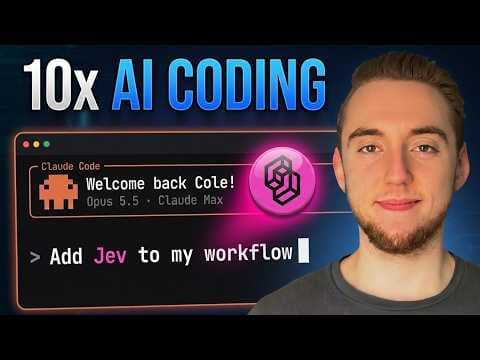
The speaker presents four practical use cases for Jev, a browser agent, in AI coding workflows: guarding a coding agent with a security hook, playtesting a game to catch bugs that unit tests miss, driving browser testing on a real app, and classifying GitHub issues and pull requests so that Archon workflows select the right steps and the right model. The speaker emphasizes that Jev never works alone—the LLM sets Jev up and acts on what it finds, while Jev makes fast and cheap decisions in between, which helps with token efficiency and rate limits. The speaker promotes a Dynamous workshop on Friday, October 2nd and links to the jev-ultrafast browser agent and the jev-use repository, which shows more examples of Jev working with an LLM.
The video examines OpenAPPA, an open-source project by Archestra AI that claims to solve agent prompt injection. It opens by referencing a reported incident in which an OpenAI agent allegedly hacked the Australian Medica…
Read full summary
The video examines OpenAPPA, an open-source project by Archestra AI that claims to solve agent prompt injection. It opens by referencing a reported incident in which an OpenAI agent allegedly hacked the Australian Medicare database. The presenter contrasts three approaches to stopping rogue agents: Nvidia's hardware solution (a monitor agent on a separate processor that quarantines the primary agent the moment it leaves its sandbox), Claude Code and Codex's approach (a second LLM agent that babysits the first, which Anthropic tried to strengthen by hiding what the first agent read, yet only works about 99% of the time), and OpenAPPA's software approach. OpenAPPA is inspired by a 50-year-old military model for handling classified documents: data can only exist in rooms rated for its classification level, and nothing read in a room can leave it. Once an agent reads private data, its session is classified as private, so subsequent requests to send data to a lower level are blocked. OpenAPPA sits between Claude Code and its tools, running outside the agent's loop, making refusals deterministic and traceable. The presenter tested it against a proprietary 'horse matching algorithm' stored in a private file; under OpenAPPA, opening the file labeled the session private, and a request to upload it to a public GitHub repo was stopped pending manual sign-off. However, the presenter notes limitations: in a head-to-head against Claude Code's auto mode, OpenAPPA completed only 75% of jobs,
The GitHub Blog announces that the HydraFusion research preview is now available in Visual Studio Code and the GitHub Copilot app, expanding beyond Copilot CLI. HydraFusion appears in the model picker.
In this video by Matt Wolfe, the author tests Claude's Opus 5.5 coding model by letting it run his Megabonk game test for nearly 20 hours, describing the result as 'kind of insane.' He notes that Opus 5.5 is available on…
Read full summary
In this video by Matt Wolfe, the author tests Claude's Opus 5.5 coding model by letting it run his Megabonk game test for nearly 20 hours, describing the result as 'kind of insane.' He notes that Opus 5.5 is available on Claude's Pro, Max, Team, and Enterprise plans, starting with the $20/month Pro plan, and that the API costs $4 per million input tokens and $20 per million output tokens. He highlights the model's price-to-performance ratio for long-running coding tasks.
A recap of OpenAI Dev Day 2026 by Matthew Berman covering several announcements. DOTS is OpenAI's always-on personal AI assistant competing with Grok, Muse, and Instinct and inspired by OpenClaw; it lives within ChatGPT…
Read full summary
A recap of OpenAI Dev Day 2026 by Matthew Berman covering several announcements. DOTS is OpenAI's always-on personal AI assistant competing with Grok, Muse, and Instinct and inspired by OpenClaw; it lives within ChatGPT, controls ChatGPT and Codex threads, connects to personal accounts (Gmail, Google Docs, Calendar), and its conversations don't count toward usage unless they control threads. Ultrafast is GPT-6 Astra powered by Cerebras chips, running eight times faster but at six times the cost; a new Pro 500 plan ($500/month) offers 25x usage limits. GPT-6.1 is described as affordable, fast, and near GPT-6 Astra quality at a fraction of the price ($2 per million input, $10 per million output). Codex updates include Codex in the Cloud, a refreshed Codex CLI with voice control, Codex code review, a Decisions API, a plugins relaunch, 'Sign in with ChatGPT + bring your tokens,' and ChatGPT Space Links.
A GitHub Blog post announces that GPT-6.1 Sol, the latest model from OpenAI, is now generally available and rolling out in GitHub Copilot. It can be used for agentic coding and terminal workflows with strong multistep ca…
Read full summary
A GitHub Blog post announces that GPT-6.1 Sol, the latest model from OpenAI, is now generally available and rolling out in GitHub Copilot. It can be used for agentic coding and terminal workflows with strong multistep capabilities.
This Everlast AI video by Leonard discusses AI recursive self-improvement. A 23-year-old DeepSeek researcher, identified as Leo Sheng You / Liu Shengyu, an alumnus of Peking University's Turing class since April 2025, pu…
Read full summary
This Everlast AI video by Leonard discusses AI recursive self-improvement. A 23-year-old DeepSeek researcher, identified as Leo Sheng You / Liu Shengyu, an alumnus of Peking University's Turing class since April 2025, published a roughly 3000-character essay titled 'Ich muss mein Talent im gestern begraben' that reached #1 on the largest Chinese knowledge platform within 48 hours. He writes 'kernels' - programs executed billions of times when a model answers - previously this role belonged to DeepSeek V4.1's attention cell. He predicts that within a year the kernels an AI writes will be as good as or surpass his own. The video cites that Claude at Anthropic now independently leads 26% of its own AI research (under 1% in February), that at OpenAI 3.1 agent workdays occur per human workday and that since June agent compute time exceeds human work time, and that Serge Brin directs over 1000 researchers at Google on this 'kernel'. Dario Amodei reportedly demanded a speed limit for this ability on September 12, with Sam Altman and Elon Musk agreeing publicly the same day. Jürgen Schmidhuber, called the father of AI by the New York Times, traces self-improvement algorithms to his 1987 thesis. Recursive self-improvement means a system can examine and replace its own learning method. Google DeepMind describes four types: code, hardware (chips), data, and more. OpenAI's first own inference chip, Jalapeno, was completed in about 9 months with help from an internal model. The video uses
In a video by Nate Herk, Claude Sonnet 5.5 is tested against Opus 5.5 across seven real workflows (landing pages, messy data turned into spreadsheets, motion design/video editing, live dashboards, project planning) to de…
Read full summary
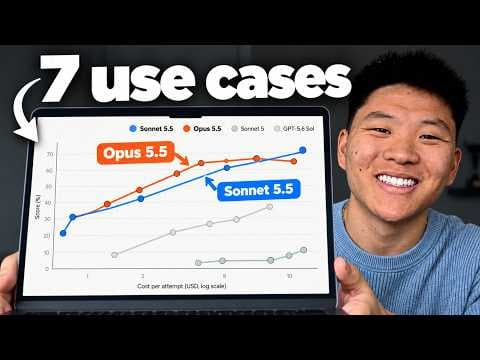
In a video by Nate Herk, Claude Sonnet 5.5 is tested against Opus 5.5 across seven real workflows (landing pages, messy data turned into spreadsheets, motion design/video editing, live dashboards, project planning) to determine when to use each model. Sonnet 5.5 is described as a clear upgrade over Sonnet 5, running 30% faster and costing 30% less for most work. Pricing: Sonnet 5.5 costs $2 per million input tokens and $10 per million output tokens, while Opus 5.5 costs $4 and $20 respectively—roughly double. Drawing on Claude's own guidance, Sonnet suits well-scoped, high-volume, clearly-specified tasks with a way to verify results (everyday coding, bug fixes, polished documents, slides, spreadsheets), whereas Opus suits complex work requiring judgment, creativity, and the most intelligence. In a landing-page demo for 'Perk Form' using identical prompts with both on high effort, Opus produced the better overall output by using real generated product images within brand guidelines, though Sonnet's hero section was stronger. Sonnet ran 28 minutes with 20M input/134K output tokens; Opus ran 52 minutes with 37M input/148K output tokens, costing about double.