Turn Your Team App Into One Colleagues Can Depend On | Heidelberg AI Curriculum
T06-L03
Turn Your Team App Into One Colleagues Can Depend On
Take the Base44 app from T06-L02 · Build a Small Shared Tool From a Prompt, and Test It With a Colleague to where colleagues can depend on it: two roles the data enforces, clear empty and error screens, a test copy with known answers, an operating note with a maintainer and deputy, and a line where IT takes over.
T06-L03 · Build apps · Level 3 Builder · 17-minute read, plus 3 hours of doing
The app that only works when you're in the room
Three months ago you built the group's antibody list in Base44, the prompt-to-app builder from T06-L02 · Build a Small Shared Tool From a Prompt, and Test It With a Colleague. It worked, and it grew. People now use it to ask the lab manager to reorder antibodies, and she orders from it every Tuesday and Friday. Then you go to a conference for a week. A new student signs in, sees an empty page and thinks the app is broken. Two requests for the same antibody arrive a day apart, and the group pays for two vials. The lab manager and her deputy both mark one request as ordered within the same minute. Nobody can tell which change counts, and the only person who knows how the app works is in Lisbon.
In a company it's the demo-kit list at a lab-equipment distributor. It started as a list of who has which pipette set. Now reps book kits for customer visits, and logistics ships from the bookings. Two reps book the same kit for overlapping weeks, and one customer visit goes ahead without a kit.
Neither app is badly built. Both have outgrown the head of the person who built them. You are at Level 3 Builder: colleagues depend on this app, and when it's wrong, their work is wrong. This book gives the app what it needs to run without you: roles the data enforces, screens that explain themselves, a test copy with known answers, and a note that lets someone else take over.
After this you can
Design two roles around what the app's table permissions can actually enforce, and test each one from its own account.
Give every screen a clear first-use, empty, no-match, refused and error state.
Keep a test copy of the app with made-up records whose right answers you know, and a test sheet a colleague reruns before every publish.
Stop two people from silently overwriting each other's change on the same record.
Write an operating note with a maintainer, a deputy and a fallback, and say where the app stops and IT takes over.
, because this book uses Base44's separate test . If your team can't pay for it, you can still do everything else and keep the test records in a duplicate of the app.
Two colleagues: one who will run your test sheet without help, and one who agrees to be the deputy maintainer.
About 3¼ hours: 17 minutes to read, about 3 hours to build and hand over, in two sessions.
Last verified 23 September 2026. Base44's test database needs the Builder plan: US$50 a month, or US$40 billed yearly. Private apps need any paid plan, from US$16 a month billed yearly. Only the Elite and Enterprise plans can restore earlier data. Details for experts at the end of this book.
The idea in one page
At Level 2 you proved the app works for one colleague on one day. At Level 3 it has to keep working for everyone, on days you're not there, after changes you haven't made yet. That takes five parts.
Part
What it answers
1. Roles the data enforces
Who may do what, set in the table permissions, not only by hiding buttons.
2. A state for every screen
What a person sees when there's nothing yet, nothing matches, they aren't allowed, or something failed.
3. A test copy with known answers
Made-up records in a separate test database, where you know in advance what every search and list must show.
4. A test sheet
Ten or so lines: which account, what to do, what must happen. A colleague runs it before every publish.
5. An operating note
Where the app lives, who maintains it, who deputises, what to do when it's down, and where it stops.
Four facts shape how you build it.
Table permissions work on whole tables. Table permissions are Base44's rules for who may read, create, update and delete the rows of each table. They can't say "members may update the notes field but not the status field". So design the roles around tables. If two roles need to change different things, either only one role updates that table, or the thing goes into its own table.
Your preview shows your view. You built the app and you're an admin. You see every row and every button. A colleague with the User role sees something else. Test each role from its own account, in its own browser window.
The last save wins unless you design against it. If two people open the same record and both save, the second save replaces the first, and nobody is told. For a team of eight that's rare, but it's exactly the kind of error nobody notices until the invoice arrives.
Every prompt can change something you didn't ask for. Base44's AI builder, the part that turns your prompt into code, rewrites code to make your change, and sometimes it touches a screen or a rule next to it. That's why the test sheet exists, and why it runs after every change, not once.
What stays yours: the roles, the known answers and the decision that a change is ready to publish. The AI builder writes screens. You decide what correct means.
Structure it. Aylin, the postdoc who built the antibody list, writes down what the group now expects. "Group members ask for an antibody to be reordered in the app. Petra, the lab manager, and Jonas, her deputy, order from the requests on Tuesdays and Fridays and record what they ordered. A good result: nobody orders the same antibody twice, every request shows its status, and the app runs for a week without me."
Understand it. Before prompting, she sits with Petra for twenty minutes and goes through the last month's requests, which came by email and sticky note. Three things come out. Petra sorts requests oldest first, because the oldest ones hold up experiments. About one request in ten is a duplicate of an open one. And people want to fix a typo in their request after sending it.
Her first design follows the last point: members create requests and may update their own (Creator Only on update, the rule that lets only the person who created a row change it), and Petra and Jonas update any request. Then she checks what the table can enforce. Creator Only on update lets a member change every field of their own request, including the status. A student could mark his own request as ordered, and Petra would never see it. Hiding the status dropdown from members wouldn't change that, because the permission is on the table.
Back to Structure it: "Members create requests and read all of them. Only Petra and Jonas update. A member who made a mistake creates a new request and writes 'replaces R-17' in the reason; Petra declines the old one. Before a new request is saved, the app warns if an open request for the same antibody exists." Losing the typo fix costs a little convenience. In return the status means what it says.
She writes the design down before she touches the AI builder. In plain words: one new table for requests; every member can create and read requests; only the two managers can change them; only admins delete. To tell members from managers she plans a field called app_role to the User table, Base44's built-in list of everyone who can sign in. User Property Check is the permission rule that reads that field:
app_role field on the User table: member or manager
OrderRequests permissions
Read and Create: User Property Checkapp_role is member, or is manager. Update: app_role is manager. Delete: admins only
Screens
"New request" form with duplicate warning; "Open requests" list, oldest first; each request shows who asked and when
Exclusions
No prices, no supplier accounts, no emails, no connection to the purchasing system
Choose tools. She stays in Base44. The group already knows it, the data is in it, and the two things she needs, a role field checked by the table permissions and a separate test database, are built in. The group upgrades the team account to the Builder plan for the test database. The alternative she considers is Lovable, whose built-in database runs on Postgres, a widely used database, with security rules written in SQL, its query language. Those rules can be finer than whole tables. It would also mean rebuilding and re-testing an app that works. That's a good trade only when the Base44 rules can't express what you need. Hers can.
Build it. She switches on Test Data first, which gives the app a second, empty database for trying things, so nothing she tries touches the real list (the clicks are in Details for experts). Then she fills the test database by hand in Dashboard → Data, with the Test switch on: six made-up antibodies and six made-up requests. Because she typed them herself, she knows the right answer to every question the app will be asked:
Test record
Why it's there
Antibodies TEST-anti-GFP and TEST-anti-GFP-HRP
A search for "gfp" must find exactly these two
Request R-01 (requested, 20 days old)
Must be first in the open list
Request R-02 (requested, anti-Actin)
A new request for anti-Actin must trigger the duplicate warning
Request R-03 (arrived) and R-04 (declined)
Must not appear in the open list
Requests R-05 and R-06 (requested, newer)
With R-01 and R-02, the open list must show exactly four, R-01 first
She counts the open requests twice before writing that last number down.
Then she builds in small steps, one prompt each. After every step she opens the testing link (Publish → Testing link), which shows her unpublished changes working on the test data only, and runs the matching lines of her test sheet.
The first prompt, in plain words: make the requests table, a form to fill it in, a warning when the same antibody already has an open request, and a list of open requests, oldest first. The last line, Change nothing else, keeps the AI builder away from the rest of the app:
Add a table OrderRequests with fields: antibody (text), catalogue_number
(text), supplier (text), quantity (number, 1-20), reason (one of: running
out, new experiment, replaces earlier request), status (one of: requested,
ordered, arrived, declined; new requests always start as requested).
Add a "New request" page with a form for everything except status.
Before saving, check if an OrderRequest with the same antibody and status
"requested" or "ordered" exists. If so, show "An open request for this
antibody already exists (R-xx, requested by ... on ...). Save anyway?"
Add an "Open requests" page listing status requested or ordered, oldest
first, showing who created each request and when.
Change nothing else. No emails, no prices, no integrations.
She asks the AI builder only to add the app_role field to the User table. The permissions she sets by hand, as in T06-L02 · Build a Small Shared Tool From a Prompt, and Test It With a Colleague: the four rules under Dashboard → Data → OrderRequests → Permissions. She doesn't ask the AI builder to do this. A rule you set and read yourself is one you can explain to the deputy.
The second prompt adds the states. The first draft of the "Open requests" page shows an empty table when nothing is open, and a raw error message when a member's save is refused. In plain words, she asks for a sentence instead of every blank table or raw error, one that says what's going on and what to do next:
On every page, show a clear message instead of an empty table or a raw error:
- first visit, no records yet: explain what this page is for and show the
  "New request" button
- no open requests: "Nothing to order right now."
- search with no results: "No antibodies match '<search>'." and a Clear button
- action not allowed: "Only the lab manager can change a request's status.
  Ask Petra or Jonas." Show no record details in this message.
- save failed for another reason: "This wasn't saved. Check your connection
  and try again. If it keeps failing, tell Aylin."
Keep every form's entries when a save fails. Change nothing else.
The third prompt deals with Petra and Jonas working at the same time. In plain words: just before a manager's change is saved, look at the request again; if someone changed it in the meantime, don't save, and say who did:
When a manager changes a request's status, reload that request first.
If its status is different from what the page showed when it was opened,
don't save. Show: "This request was changed to <status> by <name> at
<time>. Reload to see the current version." Change nothing else.
This narrows the window to a second or two, which is enough for a team of eight. A database that refuses the second save outright is the kind of thing that belongs to Level 4.
Now the test sheet, a table in the operating note with one line per thing that must be true. To run a line, sign in as the account in the second column, do what the third column says, and compare what you see with the last column:
#
Account
Do this
Must happen
1
Signed out, private window
Open the testing link
Sign-in page, no records
2
Member
Search "gfp"
Exactly TEST-anti-GFP and TEST-anti-GFP-HRP
3
Member
Search "xyz"
"No antibodies match 'xyz'" and a Clear button
4
Member
Open "Open requests"
Four requests, R-01 first; R-03 and R-04 absent
5
Member
New request for anti-Actin
Duplicate warning naming R-02
6
Member
New request for anti-Tubulin, quantity 2
Saved with status requested, appears last
7
Member
Try to change R-01's status
Refused, with the "Only the lab manager" message
8
Manager
Mark R-01 as ordered
Saved; R-01 still in the list as ordered
9
Manager, two windows
Open R-05 in both; mark ordered in one, declined in the other
Second save refused with the "was changed" message
10
Manager
Mark R-06 as arrived
R-06 leaves the open list
Line 7 fails on the first run: the app shows the refusal message, but it also shows the request's catalogue number in the message text. She asks the AI builder to remove it, reruns lines 7 to 10, and all pass. After the lines pass, she runs Base44's built-in security scan from the Security tab and reads what it reports before she publishes.
Hand it over. The part that makes the app the group's is the operating note, kept next to the app in the group's shared folder. It answers five questions: where the app is and who looks after it, who may do what, how to change it safely, what to do when it's down, and how the data is backed up. Collaborators are people invited to edit the app, not just use it. CHANGES.md is a plain text file with one line per published change. CSV is a plain table file any spreadsheet opens:
# Antibody list and reorder requests

Link: <app link>. Private: only invited group members can sign in.
Maintainer: Aylin. Deputy: Jonas. Team account holder: the group leader.
Editor access: Aylin and Jonas, invited as collaborators.
Plan: Base44 Builder, paid by the group, renews in March.

## Roles
member: search antibodies, create requests, see all requests.
manager (Petra, Jonas): change request status.
To make someone a manager: Dashboard -> Data -> User -> app_role.

## Before you publish any change
1. Make the change in the editor.
2. Run the whole test sheet (below) through the testing link.
   Every line must match. If one doesn't, don't publish.
3. Publish. Write the date and the change in CHANGES.md.
If a published change breaks something: editor -> Version History ->
restore the last good version, then tell the group.

## When the app is down
Requests go by email to Petra with "Reorder" in the subject.
Aylin or Jonas enters them into the app afterwards.

## Backups
Every Friday: export Antibodies and OrderRequests as CSV
(Dashboard -> Data -> table -> More actions -> Export) to /group/app-exports/.
Our plan can't restore old data, so these exports are the backup.

## Where it stops
No prices, no personal data beyond names, no connection to purchasing.
For any of those, talk to IT first.

## Test sheet
<the ten lines>
Then the rerun. She gives the note to Jonas, who didn't build anything, and asks him to make one small change on his own: rename the reason "new experiment" to "new project". He makes the change, runs the test sheet through the testing link and finds that line 5 now fails, because the AI builder also shortened the duplicate warning. He restores the wording with a second prompt, runs the sheet again, and publishes. That's the operating note doing its job: the change that broke something never reached the group.
What it taught her: the new table took one evening. The roles, the test copy and Jonas's rerun took twice as long, and they're what let her go to the next conference without her laptop.
Company: kit bookings in the demo-kit list
Structure it. Marco, the sales rep who built the demo-kit list, writes: "Reps book a demo kit for a customer visit. Svenja in logistics ships it and marks it returned and checked. A good result: no kit is booked twice for the same days, and Svenja sees next week's shipments on Monday morning."
Understand it. He looks at the last two months. The double bookings all have the same cause: a rep books by looking at the list, and another rep books the same kit ten minutes later from his phone. His first idea is to let reps edit their own bookings to move the dates. The same table rule stops him that stopped Aylin: a rep who can update a booking can also mark it shipped. Back to Structure it: reps create and cancel bookings through a request; only logistics updates. And the app must refuse, not just warn, when the dates overlap an existing booking.
Choose tools. Same Base44 app, same Builder plan, with the sales lead's agreement. The overlap rule is the one piece he can't set in the table permissions, so he asks the AI builder for it as a check before saving, and makes it a known-answer line in the test sheet.
Build it. His test copy has six made-up kits and four bookings, one of them TEST-K-03, booked 12 to 20 November. His key test line reads: Rep: book TEST-K-03 for 10 to 14 November → refused, "TEST-K-03 is booked 12–20 Nov". A second line checks the edge: book TEST-K-03 for 21 to 23 November → saved. The first run fails the edge: the AI builder treated the 20th as overlapping the 21st. He fixes the prompt, and both lines pass. Svenja runs the whole sheet on her own the following week. Her operating note has one line Aylin's doesn't: "If the app is down, bookings go into the shared calendar 'Demo kits' and Svenja copies them in."
Where it stops. In week three the sales lead asks whether the app could create the shipping order in the company's ERP system, the central business software for orders and stock. Marco writes it into the note as the first thing that isn't his to build. Connecting to company systems, using the company's own sign-in and keeping records the company must keep is Level 4 work with IT, and T06-L04 · Put Your Team App on the Organisation's Own Database, and Prove You Can Restore It starts there.
In both cases the AI builder wrote the screens in minutes. What made the apps dependable was deciding what the table can enforce, writing down right answers first, and watching someone else change the app safely.
Other systems need to read or write it: purchasing, ERP, the institute's sign-in.
Losing a day of data would cost more than a morning's work to re-enter. On most plans you can't restore earlier data, only export it.
More than two roles or more than one team need different views of the same table.
Nobody is left who can maintain it. A deputy is the minimum.
Stopping isn't failing. The app did its job: it showed what the team needs, and the test sheet shows IT exactly what it must do.
What goes wrong
Buttons hidden, table open.Symptom: members can't see the status dropdown, but one of them changed a status anyway, through a page the AI builder added later. Fix: set the rule in the table permissions, then test the refused action from a member's account, as in line 7.
Testing as yourself.Symptom: everything works for you; the first member sees an empty page. Fix: one account per role, each in its own browser window, and at least one line of the test sheet per role.
Known answers you never checked.Symptom: the test passes, but the expected result was wrong from the start. Fix: write the expected results from the records you typed, count again before the first run, and include a record that must not appear.
The sheet runs once.Symptom: a small change in April breaks the duplicate warning, and nobody notices until two vials arrive. Fix: the whole sheet before every publish, written into the operating note as a step, not a suggestion.
Real data in the test copy.Symptom: someone copies the real list into the test database "to make it realistic". Fix: test records are made up and start with TEST-. The test database is for known answers, and you only know them for records you invented.
No fallback.Symptom: the app is down on a Friday and nobody knows how to request an antibody. Fix: one line in the note and one sentence in the app's error message: where to go instead, and who enters it afterwards.
The deputy on paper.Symptom: you're away, the app breaks, and the deputy has never opened the editor. Fix: the deputy makes and publishes one real change, with the test sheet, before you call the app handed over.
Do it yourself (3 hours, two sessions)
Structure it (15 min). Write two sentences: who depends on the app, for what, and what "working without me" means. Name the two roles.
Understand it (25 min). Go through a month of the work with the person who depends on it most. Find the duplicates, the conflicts and the edits people want. Check each planned role against what the table permissions can enforce, and rewrite your design if they can't.
Choose tools (10 min). Confirm Base44 still fits, or name what it can't express. Check the plan has Test Data, and agree who pays.
Build it: test copy and sheet (40 min). Switch on Test Data. Type in six to twelve made-up records starting with TEST-. Write a test sheet of about ten lines with known answers, at least one per role, one refused action and one conflict.
Build it: roles, states and the save check (50 min). Add the role field and set the table permissions yourself. Prompt for the screens, the states and the save check, one prompt at a time, running the matching sheet lines through the testing link after each.
Build it: note and rerun (40 min). Write the operating note. Give it to your deputy. Watch them make one small change, run the whole sheet and publish, without your help. Fix the note wherever they got stuck.
Exit check
What you hand in: a published Base44 app and its operating note, with:
two roles set in a User field and enforced in the table permissions;
a test database with made-up TEST- records;
a test sheet of about ten lines with known answers, covering each role, one refused action, one empty state and one conflict;
the operating note: link, maintainer, deputy, account holder, publish steps, fallback, weekly export, and where the app stops;
the rerun: the date your deputy ran the sheet and published a change.
It passes when a colleague who didn't build the app runs the whole test sheet through the testing link and every line matches, and the deputy has published one small change without your help.
Rule to remember
An app is the team's when someone else can change it, test it and publish it without you.
Details for experts
Checked on 23 September 2026. You don't need this to follow the book; it's for setting things up or answering a colleague.
What
Details
What it means for you
Base44 plans
Paid plans start with Starter at US$16 a month billed yearly; yearly billing saves 20%. Builder costs US$50 a month, or US$40 billed yearly.
Budget for Builder if you want the separate test database.
Private visibility
Needs a paid plan. Set it under Dashboard → Overview → App Visibility.
Private means only invited people can sign in. Set it before you invite anyone.
Invited people
Get the role Admin or User. Neither can open the editor or the dashboard.
Your deputy must also be invited as a collaborator, and be a member of the team's workspace first, or they can't change the app.
Table permissions
Dashboard → Data → (table) → Permissions → Edit. Four rule types: All Users (anyone, even signed out), Creator Only, Entity-User Field Comparison (a field in the row must match the signed-in person) and User Property Check.
Matching any one rule gives access, so a loose rule opens the table whatever the stricter ones say. Rules cover whole tables, not single fields.
Role field
You can add your own field, such as a role, to the User table and check it with User Property Check.
This is how app_role in the example works.
Test Data
Builder plan and higher: Dashboard → Settings → Advanced Capabilities → Test Data creates a new, empty test database. The published app always uses the real data.
Fill it by hand with TEST- records. They never mix with the real list.
Testing link
Publish → Testing link shares your unpublished changes with the test data only.
Send this link to whoever runs the test sheet.
Version History
In the editor, it restores earlier versions of the app's code and design. Restoring earlier data is only on Elite (7 days back) and Enterprise (30 days).
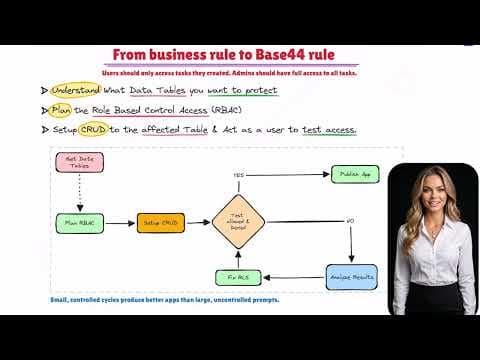
How to Secure Base44 Apps with Row-Level Security (RLS Setup Tutorial)
How to Secure Base44 Apps with Row-Level Security (RLS Setup Tutorial)Shay Bar | Secure AI Solutions & Vibe Coding
T06-L03: Learn why hidden buttons do not protect records, and how a permission matrix becomes Base44 database rules. This August 2026 tutorial supports access-control design, not concurrency or handover. Its Creator Only example is not the book's manager-only update policy; retain the book's separate-account denial tests.
Vercel Product Walkthrough (2026)Vercel (official) · 10 min
See how deployment, AI development and team previews fit together in Vercel's workflow. The complete automatic caption text was reviewed; production performance, pricing, security and the generated hiring recommendations were not independently assessed.
13 minBuild and deploy a full app with Base44 in 2026 (full tutorial)
Build and deploy a full app with Base44 in 2026 (full tutorial)No Code MBA · 13 min
T06-L02: Follow a sponsored Base44 prototype build through follow-up prompts, data inspection and a second-account check after publication. Use the book for private invitations, persistence tests and export.
Developing macOS Apps with AI: Complete Guide (2026)
Developing macOS Apps with AI: Complete Guide (2026)Video · Alex Sprogis · Oct 20, 2026
In this guide, content creator Alex Sprogis explains how he built a personal macOS menu bar app that monitors system performance and helps free up hard drive storage, using AI coding agents. He walks through his structured process: first drafting a product briefing that defines the target audience, platform, features, and what to exclude (since coding agents tend to overengineer), then creating a visual prototype in Claude Design (claude.ai/design) to lock in the app's look before coding, and finally having a coding agent implement the app using specifications to keep the agent organized on larger projects. He recommends native Swift development with Xcode for accessing OS system functions, and mentions using Claude Code, Cursor, and ChatGPT/Codex as coding agents.
How to Use REA to Copy Any App in Minutes (Reverse Engineer Anything)
How to Use REA to Copy Any App in Minutes (Reverse Engineer Anything)Video · Alex Sprogis · Oct 13, 2026
Alex Sprogis's video explains REA (Reverse Engineer Anything), an open-source MCP server for reverse engineering binaries, applications, and runtime behavior, which gained over 120,000 GitHub stars within days. REA acts as a bridge between a coding agent and analysis tools/decompilers such as Ghidra, IDA, and Hopper, using its own analyses for JavaScript/Electron apps and Chrome for websites. The creator tested REA on an Electron-based dictation app (where AI contributed little and the MCP analysis timed out after 30 minutes, while the command line took 5 minutes) and on macOS Reminders (where AI found the data model, permissions, and functional areas, though core logic in shared macOS memory was inaccessible). The video includes a legal disclaimer against copying code one-to-one, circumventing licenses, or manipulating apps. It also references Brandon Thomas's open-source Photoshop clone, Photocraft, and replicas of other Adobe programs.
T3 Code: FINALLY a control center for ALL your coding agents (Open Source!)
T3 Code: FINALLY a control center for ALL your coding agents (Open Source!)Video · Alex Sprogis · Oct 7, 2026
T3 Code is a free, open-source 'agent harness control service'—a control center for coding agents—created by developer Theo Brown. Available as a desktop, web, and mobile app, it unifies multiple coding agents and models (Claude Code, Codex, Cursor, Grok, Antigravity, Open Code, and GitHub Copilot) into one interface, letting users switch between agents mid-conversation and manage parallel sessions. It runs on the official Claude Code CLI, so it can be used with existing subscriptions. The app auto-detects subscriptions, supports Git, GitLab, and Azure DevOps, and offers features like diffs, an integrated browser, and pull request management. It runs with full access by default but can be switched to auto mode to block destructive commands.
Opus 5.5: Web Design Is FINALLY Fun Again (No More AI Slop!)
Opus 5.5: Web Design Is FINALLY Fun Again (No More AI Slop!)Video · Alex Sprogis · Sep 28, 2026
The video explains how to build websites that no longer look like AI-generated 'slop' using Claude Opus 5.5 (released by Anthropic and described as leading benchmarks). The presenter follows a structured four-step workflow across five example projects: a SaaS landing page, two e-commerce sites, an agency website, and a creative hobby project. Step one is collecting inspiration from web-design platforms such as Dribbble, Pinterest, Awwwards (nominated top-quality sites) and the paid Mobbin (which offers an MCP server with 6000 interface/website examples). Step two is generating a full design system via claude.ai/design, feeding in project descriptions, existing code, Figma references or uploaded assets. The presenter also mentions using license-free asset libraries like Lottie. The final step uses JavaScript libraries GSAP and Three.js to add 3D objects, cameras, lighting/shadow simulation, scroll animations and product configurators, turning sites into 'digital experiences'. Cookiebot is mentioned as a cookie-consent tool.