Predict a Protein Structure and Read Its Confidence Honestly | Heidelberg AI Curriculum
T18-L02
Predict a Protein Structure and Read Its Confidence Honestly
Run a structure prediction on the free AlphaFold Server, read pLDDT, PAE, pTM and ipTM for what they do and don't say, cross-check with a BLAST search against the PDB, and write a confidence note that a labmate can check against the same files before anyone designs a construct from it.
At group meeting, a PhD student shows a predicted structure of the protein you're all working on. It's a beautiful ribbon, coloured blue and orange. Someone asks: "So which part do we delete for the construct?" Someone else asks: "Is the peptide really binding there, or is that just where the model put it?" Nobody can answer from the slide, because the slide doesn't say what the colours mean or how sure the model was.
In a cell-biology lab the question is where a fluorescent tag can go without breaking the protein. In a structural lab it's which region to express, or whether a binding partner sits where you think it does. In both cases people will spend weeks of bench time on the answer.
AlphaFold Server, Google's free website that predicts a protein's 3D structure from its sequence, gives anyone a prediction in minutes for non-commercial research. It also gives you its own confidence scores, and they're honest if you read them honestly. This book shows you how to run a prediction, read the scores for what they say, check them against one independent source, and write a note your group can check. You are at Level 2 Power user: your labmates will see your result and may act on it, so your reading has to be checkable.
After this you can
Submit a protein or protein–peptide prediction to AlphaFold Server within its terms and daily quota.
Read pLDDT, PAE, pTM and ipTM and say which parts of a prediction are confident and which aren't.
Run a BLAST search, a sequence similarity search, against the PDB, the public archive of experimental structures, to find out whether an experimental structure, or a close relative, already exists.
Write a confidence note that a labmate can check against the downloaded files.
A Google account and a browser. AlphaFold Server runs on Google's side, so any laptop will do. You don't install anything.
Eligibility. You must be an individual or at a non-commercial organisation (university, non-profit research institute, public body), working on non-commercial research. Research on behalf of a company is excluded, even at a university. If that's you, use the AlphaFold Database instead (see the last pitfall).
Your sequence must be publishable. Don't submit unpublished sequences your institution or a collaborator treats as confidential. Google's terms say it won't publish your input or output without your approval, but that's a question for your group's rules, not for you alone.
About 60 minutes: 14 to read, about 45 to do, including the wait for the job.
Last verified 23 September 2026. AlphaFold Server is free for non-commercial research with a Google account; company work and docking tools that predict binding are excluded. You get 30 jobs a day, each up to 5,000 amino acids. Details for experts at the end of this book.
The idea in one page
AlphaFold predicts where every atom sits, and then scores its own confidence. The scores are the part you report. Four of them matter:
Score
What it tells you
How to read it
pLDDT (0–100, per atom)
How sure the model is about the local structure: is this helix really a helix here?
Above 90: very high. 70–90: high. 50–70: low. Below 50: probably wrong, often a disordered region. The ribbon is coloured by it.
PAE (in Å, ångström, a tenth of a nanometre; for every pair of positions)
How sure it is about where one part sits relative to another: domain to domain, peptide to protein.
Dark (low error) blocks = parts placed confidently relative to each other. Light between two domains = their arrangement is a guess, however good each domain looks.
pTM (0–1, whole model)
Overall fold confidence.
Above 0.5: the overall fold may be right. Unreliable for very small chains.
The scores measure certainty, not correctness. They say how sure the model is. A protein that was in the PDB before September 2021 was probably among the structures the model learned from, and can be found as a template, a known structure the server copies from, so a good match to that structure tells you little about how it would do on your new protein.
Short peptides break pTM and ipTM. For chains under about 16 residues, the server's FAQ page warns that pTM comes out very low whatever the quality. Read a peptide's placement from its pLDDT and from the PAE between peptide and protein.
Low pLDDT often means flexible. Very low values usually mark a region that is disordered in solution. That's information, as long as you don't read the drawn shape of that region as real.
The sequence task. Before you trust a prediction, ask whether an experimental structure already exists. BLAST your sequence against the PDB: an identical or close hit gives you a real structure to compare with, and tells you the prediction may simply echo it.
Research situation 1: an imaging lab planning a fluorescent fusion
Structure it."We want to image autophagosomes with a fluorescent LC3B fusion. I need to know which end of LC3B can carry the tag without disturbing the folded part. A useful result: a recommendation my supervisor can check in ten minutes."
Understand it. She opens alphafoldserver.com and signs in with her Google account. She copies the UniProt FASTA of LC3B, the sequence in the plain-text format sequence tools accept (125 residues), and pastes it into the sequence box; the server recognises one protein chain. She clicks Continue and preview job, then Confirm and submit job. Five minutes later the job in the History list shows as finished. She double-clicks it, and the results page shows a compact fold, almost all dark blue, with a short, pale tail at the C-terminus and the first residue or two slightly paler. Her first thought: the C-terminal tail is flexible and sticks out, so that's the place for the tag. Then she opens the UniProt entry to cite the residue numbers and finds the Features section: residues 121–125 are a propeptide, cleaved after glycine 120 by ATG4B, and glycine 120 is where LC3B is lipidated, attached to the autophagosome membrane. A tag on the C-terminus would be cut off in the cell, and she'd be imaging an untagged protein. The prediction answered a structural question. Her question was biological. Back to Structure it: "Which end is free and survives processing in cells?"
Choose tools. Going down the ladder from T01-L01 · From Idea to Working Result: The Four-Quadrant Method, simplest source first: the literature and UniProt already describe the processing, and the usual construct in the field is an N-terminal fusion. The prediction's job is narrower: show that the N-terminus is near the surface and not buried in the fold. AlphaFold Server does that. The AlphaFold Database entry for the same protein (AF-Q9GZQ8-F1 (opens in a new tab)) is a free second opinion from a different model version. BLAST against the PDB tells her whether experimental structures exist.
Build it. She clicks Download on the results page and unpacks the zip file. In the ..._summary_confidences_0.json file, the scores file for the top-ranked model, pTM is well above 0.5, as expected for a small, well-folded protein. The ribbon's colours show the core in the very high band and the last few residues dropping into the low band. The AlphaFold Database model shows the same pattern: an average pLDDT of 91.4, with residues 116–125 falling steadily to below 50 at the very end. She BLASTs the sequence against Protein Data Bank proteins(pdb) and gets many identical hits, including 5D94, an X-ray structure at 1.53 Å. So the prediction adds little to what's known about the fold; its value for her is a quick look at where the ends sit. Her note: "N-terminus: surface-exposed in the prediction and in 5D94; recommended for the tag. C-terminus: low pLDDT tail, and cleaved after G120 in cells (UniProt), so not usable. Prediction not independent: many LC3B structures predate the template cutoff."
What it taught her: confidence scores answer "how sure is the model about this shape?". They never answer "what happens to this protein in a cell?".
Research situation 2: a structural lab checking a peptide interface
Structure it."We study proteins that bind LC3B through a short LIR motif, the LC3-interacting region of a few amino acids. Before we model our own candidates, I want to know whether AlphaFold Server places a known LIR peptide correctly, and how to read its scores for a peptide. A useful result: a reading rule for peptide predictions the group can apply to our own proteins."
Understand it. He takes the 11-residue p62 peptide from the crystal structure 2ZJD, SGGDDDWTHLS (human p62 residues 332–342, which contain the LIR motif 336–341), and pastes both sequences as one FASTA into the server; it recognises two protein chains. The result shows the peptide lying on LC3B's surface. The pTM looks worrying and the peptide's chain pTM is close to zero. His first reading: failed prediction. Then he finds the FAQ entry on short peptides: pTM is unreliable below about 16 residues, and the right scores to read are pLDDT and PAE. Back to Structure it: "For peptides, the reading rule is: pLDDT of the motif residues, plus PAE between peptide and protein. Ignore pTM for the peptide chain."
Choose tools. AlphaFold Server for the prediction. The Pairwise Structure Alignment (opens in a new tab) tool on RCSB, the PDB's US website, which accepts an uploaded mmCIF file (the structure file in the download), to compare the prediction with 2ZJD. BLAST against the PDB to confirm that 2ZJD's LC3 chain really is the same protein.
Build it. He looks at the PAE plot on the results page, selecting the block where peptide rows meet LC3B columns. For the motif residues it's dark, meaning low predicted error in the peptide's position relative to LC3B; the flanking glycines and serines are lighter. The motif residues have high pLDDT; the ends of the peptide are low. He downloads the zip, uploads the top-ranked ..._model_0.cif file to the alignment tool with 2ZJD as the reference, and sees the peptide's tryptophan and leucine sit in the same two pockets as in the crystal. Then he writes the caveat that matters most: 2ZJD was released in 2008, long before the template cutoff, so this agreement shows the scores behave sensibly on a known case. It doesn't show the model can find a new LIR interface. His note ends: "Rule for our candidates: report motif pLDDT and peptide–protein PAE; treat pTM/ipTM as uninformative for peptides under 16 residues; run at least three seeds (Clone and reuse) before believing a placement." He attaches job_request.json, the file that lets anyone rerun the job, and notes the seed, the random starting point of the run. Clone and reuse, in the job's menu in your History, reruns the same job with a new seed.
What it taught him: the headline score was the wrong score for his question. The group now has a written rule instead of a feeling.
What goes wrong
Reading the ribbon's shape in a low-confidence region.Symptom: someone designs a construct around a helix drawn in orange. Fix: treat everything below 50 as "position unknown, probably disordered", and say so in the note.
Trusting two confident domains together.Symptom: both domains are blue, so the arrangement "must be right". Fix: look at the PAE block between the domains. If it's light, the relative position is a guess.
Using pTM or ipTM for a short peptide.Symptom: a real interaction dismissed because the peptide's pTM is near zero. Fix: for peptides under about 16 residues, read pLDDT and PAE, as the FAQ advises.
Believing one seed.Symptom: a binding pose that moves when a colleague reruns the job. Fix: each job runs one seed, the random starting point that shapes the result. Rerun with Clone and reuse and automatic seeds, compare the five-model sets, and report whether the placement is stable.
Calling a known structure a validation.Symptom: "the prediction matches the crystal structure" presented as a sign the model works for your protein. Fix: check the release date of the matching entry. Before September 2021 means the model may have seen it; say so.
Feeding outputs into docking or a company project.Symptom: a predicted structure goes into AutoDock, a docking program that predicts how molecules bind, or into work for an industry partner. Fix: both are excluded by the server's Output Terms, the rules for using its results. For company work, use the AlphaFold Database, which is free for commercial use, or an experimental structure.
Do it yourself (45 minutes)
Use LC3B from the worked example, or a public protein from your own work.
Structure it (5 min). Write the decision the prediction should help with, in one sentence, and which region or interface matters for it.
Understand it (10 min). Read the protein's UniProt Features section. Note processing, modifications, known disordered regions and motifs. Then open blast.ncbi.nlm.nih.gov and choose Protein BLAST. Paste the sequence under Enter Query Sequence, set Database to Protein Data Bank proteins(pdb) and click BLAST. Identical hit, close relative, or nothing? Rewrite your question if you learned something.
Choose tools (5 min). Decide what to submit (single chain, complex, peptide) and which scores you'll read for your question. Check your remaining jobs in the submit dialogue.
Build it (25 min). Submit the job as in the worked example. When it's finished in the History list, open it and click Download for the zip. Write the note: confident regions (pLDDT band and residue range), relative positions (PAE), pTM and ipTM from the ..._summary_confidences_0.json file where they apply, one cross-check (BLAST hit, AlphaFold Database entry or experimental structure), and one sentence on what the prediction can't tell you.
Exit check
What you hand in: one prediction, with:
the downloaded zip and its job_request.json, so the job can be rerun;
a confidence note of half a page: confident regions with residue ranges, what PAE says about relative positions, the pTM and ipTM values and whether they apply, one cross-check, and one limit;
the terms notice if you share it beyond your group.
It passes when a labmate opens the same files and agrees with every claim in the note.
Rule to remember
Report the confidence, not the picture.
Details for experts
Checked on 23 September 2026. You don't need this to follow the book; it's for setting things up or answering a colleague.
What
Details
What it means for you
AlphaFold Server
Runs AlphaFold 3. Free for non-commercial use by individuals and non-commercial organisations; sign in with a Google account.
Nothing to install or pay for.
Terms of use
The Additional Terms and the Output Terms (both last modified 8 May 2024) forbid commercial activities, including research on behalf of a company; use in automated binding prediction for ligands (small molecules) or peptides, such as the docking tools Glide or AutoDock; and training structure-prediction models.
A structure from the server never goes into a docking run or an industry project.
Sharing and citing
You may publish and share outputs with a clear notice that they're subject to the AlphaFold Server Output Terms of Use, noting any changes you made. Cite Abramson et al., Nature 2024.
Put the notice on any slide or file that leaves your group.
Daily quota
The FAQ gives 30 jobs per day. The older training guide still says 20; the job dialogue shows how many you have left.
Plan seed reruns within the day's jobs.
Job size and time
Up to 5,000 tokens per job: one token per amino acid or nucleotide, one per ligand atom. Each chain needs at least 4 residues. A job of about 1,000 tokens usually takes 3 to 6 minutes.
A single protein like LC3B is far below the limit.
What a job returns
One seed (the random starting point of a run) and five predictions, ranked 0 to 4, in a zip: mmCIF structure files, summary_confidences and full_data JSON files (plain-text data files with the scores), job_request.json and terms_of_use.md.
Rank 0 is the top model. Keep job_request.json; it lets a labmate rerun the job.
Templates
By default the server searches the PDB for templates, known structures it can copy from, released up to 30 September 2021. They can be switched off per chain.
A match to an older structure isn't independent evidence.
AlphaFold Database
Precomputed AlphaFold 2 models of single chains, free for commercial and non-commercial use, no registration.
The route for company work.
NCBI BLAST
Use blastp, the protein-against-protein search, and choose the database Protein Data Bank proteins(pdb).
This is the cross-check in step 2 of Do it yourself.
AlphaFold Server: Taught. Free AlphaFold 3 predictions for non-commercial research.
Biopython: Catalogued. Reads mmCIF files and their pLDDT values when you want to compare many predictions with a script.
PubMed: Catalogued. For the papers behind a UniProt annotation before you rely on it.
Watch
Confidence metrics used in the AlphaFold Database multimers
Confidence metrics used in the AlphaFold Database multimersProtein Data Bank in Europe - PDBe
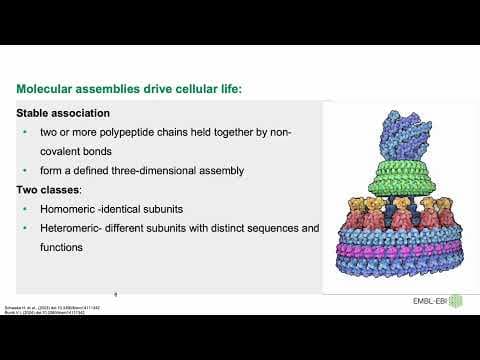
T18-L02: Learn what pLDDT, PAE and interface confidence tell you—and where they mislead—in AlphaFold Database multimers. Start at 8:04; use the book and current Server guidance for submissions and short-peptide limitations.